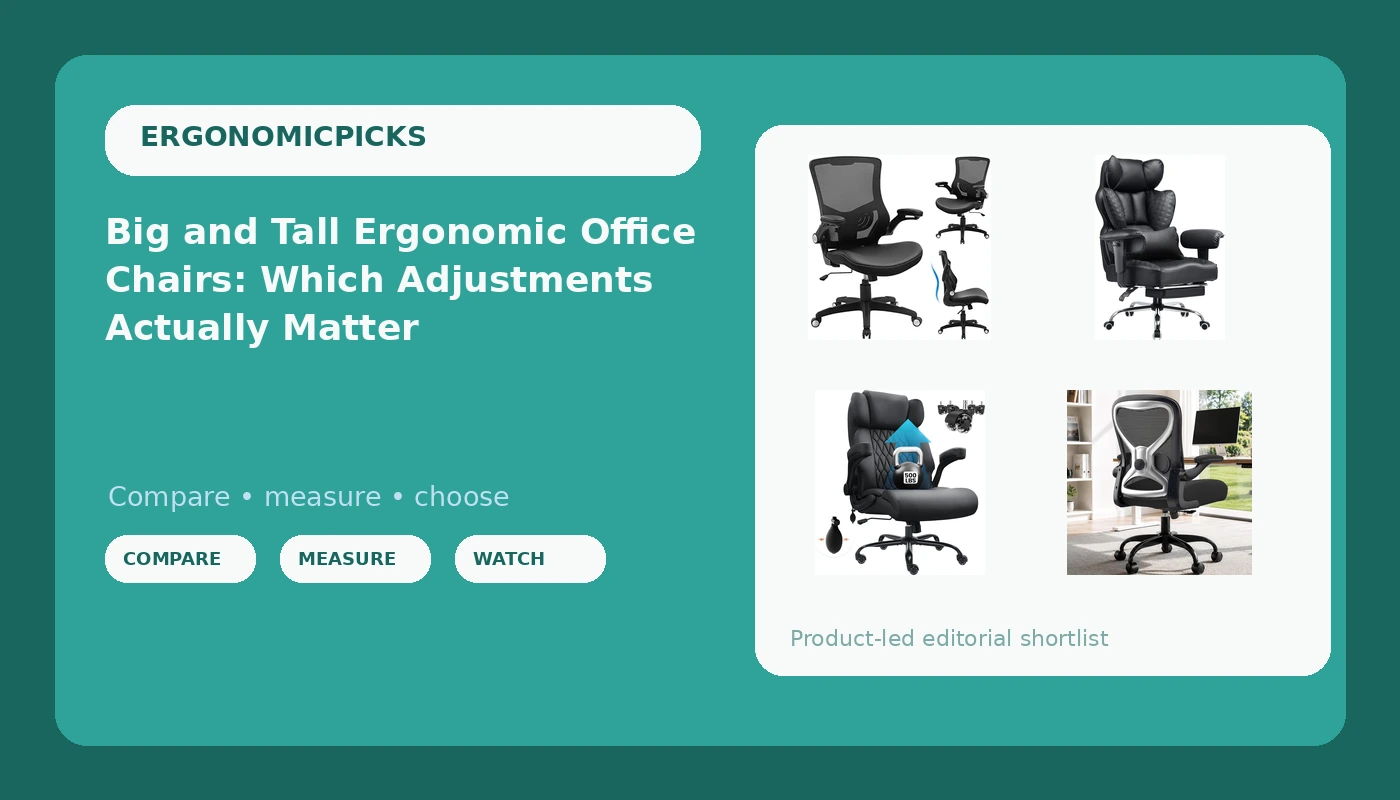
Big and tall ergonomic office chairs get sold on three numbers that almost never appear in the same listing: seat width, seat depth, and a stated weight rating. Everything else on the page, the embossing, the pillow, the racing-style bolsters, is decoration until those three are right for your body. In my ergonomics practice, the clients who come in with new low back pain after a chair swap rarely bought a bad chair. They bought a chair whose seat depth was wrong for their thigh length, or whose lumbar pad slid down the backrest by early afternoon and never came back up.
This is an explainer, not a ranking. Below are four chairs in this category, what each listing actually specifies, and how to line those specs up against your own measurements before you spend anything.
Related: How to Set Up an Ergonomic Office Chair for a Full Workday →
Quick answer
Match the chair to the constraint you actually have. If your priority is the heaviest stated weight rating in this group, the 500lbs chair is the one to look at, and it also lists an adjustable lumbar support and an extra wide seat. If you recline and want a footrest, the COMHOMA chair lists a 150 degree recline, adjustable armrests, and a footrest. If you want a lumbar support that moves in more than one direction, the 4-way lumbar chair is the one that names that adjustment. If you want flip-up arms to tuck the chair under a desk, the PU leather and mesh back task chair lists them. In every case, confirm seat depth and seat height range against your own body first, because those are the numbers that decide whether a chair works at hour six.
Four useful options
| Model | Best fit | What stands out |
|---|---|---|
| 500lbs Big and Tall Office Chair Adjustable Lumbar Support for Back Pain, Extra Wide Seat Executive Office Chair Thick Armrest Pad, Heavy Duty Base&Upgraded Wheels, Ergonomic Desk Chair | Heavier sitters who need the highest stated capacity here | 500 lbs stated rating, adjustable lumbar support, extra wide seat, heavy duty base with upgraded wheels |
| COMHOMA Big and Tall Office Chair Heavy Duty Wide Ergonomic Gaming Chair with Deluxe Embossing Designed Leather with Foot Rest,150°Reclining Adjustable Armrests Pocket Spring Back Support and Pillow | Sitters who lean back and want a footrest | 150 degree recline, adjustable armrests, footrest, pocket spring back support, pillow |
| Ergonomic Home Office Chair, 4-Way Lumbar, Thick Cushion, 330LBS | Everyday desk work with multi-directional lumbar tuning | 4-way lumbar adjustment, thick cushion, 330 lbs stated rating |
| Office Chair Ergonomic Desk Chair, Computer PU Leather Home Office Chair, Swivel Mesh Back Adjustable Lumbar Support Flip-up Arms Executive Task Chair | Tight desk spaces that need arms out of the way | Flip-up arms, adjustable lumbar support, mesh back with PU leather, swivel base |
The highest stated capacity: 500lbs Big and Tall Office Chair Adjustable Lumbar Support for Back Pain, Extra Wide Seat Executive Office Chair Thick Armrest Pad, Heavy Duty Base&Upgraded Wheels, Ergonomic Desk Chair
A high weight rating is not the same thing as a high comfort rating, and I want to be clear about that. A 500 lbs rated gas lift and base tells you the structure is built for load. It does not tell you where your lumbar curve lands once you sit down, or whether the seat pan is long enough for your femur. Those are separate questions, and they are answered by measurements, not by the rating. What the rating does buy you is margin: a chair rated well above your body weight is a chair whose cylinder, base, and welds are not being asked to work at their ceiling every day.
The recliner with a footrest: COMHOMA Big and Tall Office Chair Heavy Duty Wide Ergonomic Gaming Chair with Deluxe Embossing Designed Leather with Foot Rest,150°Reclining Adjustable Armrests Pocket Spring Back Support and Pillow
Here is the trade-off. A deep recline with a footrest is a chair that wants to be sat in two ways, working upright and leaning back, and a chair that does two things is usually making a compromise on one of them. Reclined sitting also changes your reach: your shoulders move back, so your keyboard and monitor need to move with you, or you trade lumbar comfort for neck strain. If you plan to spend most of the day typing, treat the recline as a recovery position you visit, not the position you live in.
The four-way lumbar task chair: Ergonomic Home Office Chair, 4-Way Lumbar, Thick Cushion, 330LBS
The reason I keep coming back to lumbar adjustability is that the pad has to hold its position under load. A support that slides is not a support, it is a bump that migrates. So the test when a chair arrives is not whether the pad moves. It is whether the pad stays exactly where you set it after two hours of leaning and shifting. If you have to reset your lumbar support every afternoon, you did not buy adjustable support, you bought a friction fit.
The flip-up armrest task chair: Office Chair Ergonomic Desk Chair, Computer PU Leather Home Office Chair, Swivel Mesh Back Adjustable Lumbar Support Flip-up Arms Executive Task Chair
Two honest notes about this category of chair. First, mesh is not automatically breathable and it is not automatically durable. A cheaply tensioned mesh back sags over time, and a sagging back panel stops supporting anything. Second, flip-up arms are usually a compromise on armrest rigidity, because a hinge introduces a joint. If your shoulder pain is driven by armrest height, a solid fixed-height arm you can adjust once beats a folding arm that wobbles. If your problem is a desk that is 22 inches deep, the folding arm wins.
Prices and availability may change. Product images, names, and retailer links are matched to verified listings. No current price, rating, stock status, or measured result is stated here without current evidence.
Why "big and tall" is a set of measurements, not a size tier
Big and tall is not one size. It is at least four independent dimensions, and a chair can be generous in one and stingy in another. Seat width decides whether your hips and thighs sit on the cushion or get pushed against the bolsters. Seat depth decides whether the front edge of the pan stops short of the back of your knee. Seat height range decides whether your feet reach the floor. Backrest height decides whether the top of the frame lands between your shoulder blades or in the middle of your neck.
The most common mistake I see is buying width when the real problem is depth. A wide seat that is too deep forces you to slide forward to keep your knees free, and the moment you slide forward, your lumbar curve leaves the backrest and your back does all the work. A slightly narrower seat that is the right depth will beat a wide one that is too long, every time.
The lumbar test, and how to run it in a showroom or at home
Put your hand flat against your lower back and sit all the way back in the chair. If you can slide your palm out easily with no resistance, the chair is not supporting your lumbar curve, it is just touching it. If the pad digs in hard enough that you want to shift away, it is too aggressive. What you want is firm, even contact that you can hold for an hour without thinking about it.
Then run the sequence below before you commit to anything.
- Measure the distance from the crease behind your knee to the back of your buttock while seated. That is your target seat depth, and you want the pan within roughly an inch of it.
- Measure from the floor to the crease behind your knee. That is your target seat height, and it needs to fall inside the chair's listed height range with your feet flat.
- Note your body weight and compare it to the stated weight rating, then leave margin. A rating you sit under, not at, is a rating that lasts.
- Set the lumbar support where it belongs, sit for a while, then check whether it moved. Position retention is the whole feature.
- Check the armrests under pressure. Lean on one, then the other. A wobble that shows up in the first minute shows up worse in year two.
Practical guidance before you order
- Confirm seat depth and seat height range with the seller if the listing does not publish them. Those two numbers decide fit more than any other spec.
- Treat a stated weight rating as a structural claim, not a comfort claim. It tells you about the base and cylinder, not about your lumbar curve.
- Decide whether you need adjustable armrests before you fall in love with a chair that has fixed ones. Floating elbows are a shoulder problem I see weekly.
- Budget for the five year view. A chair is a multi-year purchase, and the cheaper one that fails in 18 months was never the cheaper one.
- Plan your monitor and keyboard around your recline range, not just your upright position, or you will trade back comfort for neck strain.
- If you are between sizes, choose the chair with more adjustment rather than the chair with more cushion. Cushion compresses; adjustment adapts.
Which option should you choose?
Choose the 500lbs Big and Tall Office Chair Adjustable Lumbar Support for Back Pain, Extra Wide Seat Executive Office Chair Thick Armrest Pad, Heavy Duty Base&Upgraded Wheels, Ergonomic Desk Chair when you want the highest stated weight rating here and an extra wide seat with a repositionable lumbar support. Choose the COMHOMA Big and Tall Office Chair Heavy Duty Wide Ergonomic Gaming Chair with Deluxe Embossing Designed Leather with Foot Rest,150°Reclining Adjustable Armrests Pocket Spring Back Support and Pillow when you recline through the day and want a footrest and adjustable armrests to go with it. Choose the Ergonomic Home Office Chair, 4-Way Lumbar, Thick Cushion, 330LBS when lumbar tuning is your priority and you want a thick cushion for long desk sessions. Choose the Office Chair Ergonomic Desk Chair, Computer PU Leather Home Office Chair, Swivel Mesh Back Adjustable Lumbar Support Flip-up Arms Executive Task Chair when desk space is tight and you need arms that fold out of the way.
No independent lab measurements, pressure mapping, or long term durability data for these specific models are cited here. The fit guidance above is about matching published specifications to your own body, and specifications change. Verify the numbers that matter to you before ordering.
The bottom line
Big and tall ergonomic office chairs are a fit problem before they are a features problem. Get the seat depth and seat height range right for your body, confirm the stated weight rating leaves you margin, and insist that the lumbar support holds the position you set. The chair that does those three things will serve you better than the one with the longest feature list. Check the current listings, measure yourself honestly, and buy the chair that matches your body rather than the one that matches the marketing.