Search for an ergonomic office chair with footrest and you get a wall of listings that promise the same three things: back support, breathable materials, and a recline you will supposedly use every afternoon. What almost none of them tell you is which adjustments actually stay where you put them, whether the seat depth matches your legs, and what your lower back feels like at hour six.
That gap between the marketing and the mechanics is the entire problem. A chair is a five-year purchase, and the features that matter most are the hardest ones to photograph. The four options below sit at very different points on the price and design spectrum, from a mainstream office furniture brand to two racing-style gaming chairs and a mesh recliner with a footrest. What follows is what each one is built around, and how to decide which set of trade-offs fits your body and your desk.
Related: How to Set Lumbar Support So It Stays Put at 2 PM →
Quick answer
No single chair fits every body, and the word "ergonomic" on a listing tells you almost nothing on its own. Match the chair to the workday instead. For long, upright hours at a desk on carpeted floors, the Steelcase Series 1 is the option here built around that job. If you want a recline and a footrest at a lower entry point, the CYKOV mesh chair and the two BOSSIN gaming chairs cover that ground. The details that decide whether you keep using a chair are lumbar support that adjusts in place, seat depth that matches your thigh length, and armrests that hold their position under load.
Four useful options
| Model | Best fit | What stands out |
|---|---|---|
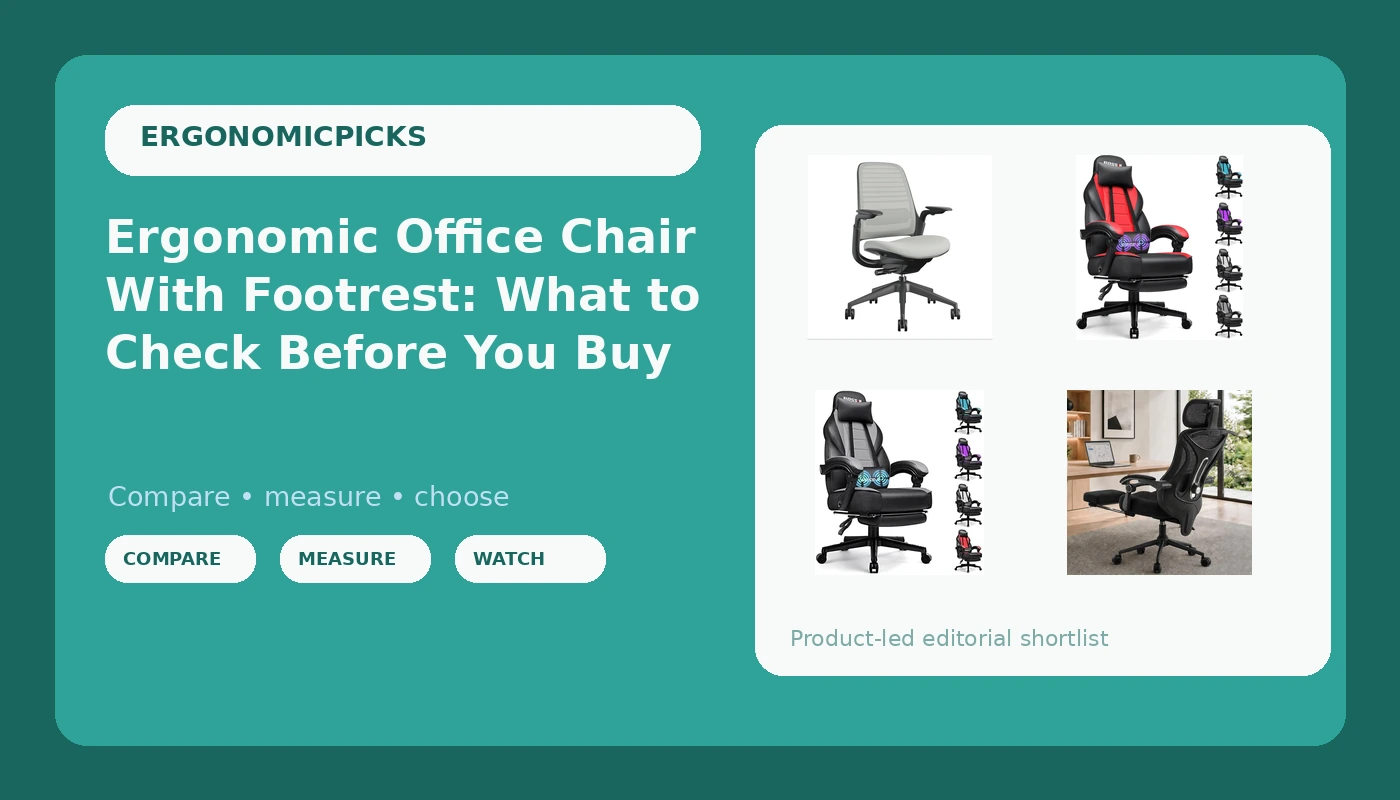
| Steelcase Series 1 Ergonomic Office Chair, Carpet Floors, Nickel | Long, upright workdays on carpet | Caster setup listed for carpet floors and a nickel finish |
| CYKOV Ergonomic Office Chair with Footrest, Reclining Mesh Back, 350 Lbs | Reclining at a desk with a footrest | Reclining mesh back plus a listed 350 lb capacity |
| BOSSIN Racing Style Gaming Chair, Leather Computer Desk Chair with Footrest and Headrest | Tall sitters who want a high back | Leather racing-style high back with footrest and headrest, sized big and tall |
| BOSSIN Gaming Chair with Massage, Ergonomic Heavy Duty Design with Footrest and Lumbar Support | Cushioned seating with a massage feature | Built-in massage plus footrest and lumbar support in a large high-back frame |
The long-haul option: Steelcase Series 1 Ergonomic Office Chair, Carpet Floors, Nickel
The reason I start here is not brand loyalty. It is that office furniture companies design for eight-hour sitting, and gaming companies design for three-hour sessions. Those are different engineering problems. A chair meant for desk work tends to be built around an upright posture, with a seat and back shaped to hold you forward rather than cradle you backward.
The trade-offs are worth naming. There is no footrest here, so if you want to put your feet up while you recline, this is not that chair. The finish is fixed at nickel, and the caster configuration is specified for carpet, which matters more than people expect: the wrong wheel type on a hard floor either scratches it or rolls away from the desk every time you lean. If your office is hardwood or tile, check the caster specification before you commit.
The budget recliner: CYKOV Ergonomic Office Chair with Footrest, Reclining Mesh Back, 350 Lbs
Here is where I have to be blunt about mesh, because the marketing around it is close to dishonest. Mesh is not automatically breathable, and it is not automatically supportive. A mesh back holds you only as well as the frame tension behind it. When the weave is loose, the back gives way under your lumbar curve and you end up sitting in a hammock with your tailbone carrying the load. That does not mean every mesh chair fails. It means mesh is a material choice, not a feature, and the honest way to judge it is over time rather than in a product photo.
The footrest and the recline are the real reasons someone buys this chair, and they are legitimate reasons. Reclining takes load off the lumbar discs and lets the seat pan carry more of your weight. The listed 350 lb capacity also puts it in a different structural class than most chairs at its entry point. What I would want to confirm before buying is whether the recline locks at defined positions or floats freely, because a tilt that will not hold is a tilt you will fight all day.
The big-and-tall gaming pick: BOSSIN Racing Style Gaming Chair, Leather Computer Desk Chair with Footrest and Headrest
Racing chairs get dismissed in ergonomics circles, and I understand why, but the dismissal misses who they actually serve. If you are tall, a standard office chair often ends with the top of the backrest somewhere near your shoulder blades, which leaves your neck and upper spine unsupported. A large high-back frame fixes that geometry problem, and for a tall sitter the headrest is a genuine addition rather than decoration.
The catch is the shape of the seat. Racing-style chairs borrow their bolsters from car seats, and those raised sides are designed to hold a body in place through a corner. If you sit upright at a desk for hours, the bolsters can push your shoulders forward and roll them inward, which is the exact posture that shows up in my clinic as upper back and shoulder pain. The footrest and headrest are real features here. The bolsters are the part to think about, especially if your shoulders are broad.
The cushioned budget pick: BOSSIN Gaming Chair with Massage, Ergonomic Heavy Duty Design with Footrest and Lumbar Support
Massage in a chair is a comfort feature, and I want to be clear that comfort and posture support are not the same purchase. A vibration motor can feel good after a long day. It does not hold your lumbar curve in place, and it does not stop you from slouching at hour four. Buy this chair for the cushioning, the footrest, and the size, and treat the massage as a bonus rather than a reason.
The lumbar support is the part to examine closely. In this class of chair, lumbar support is usually a pillow strapped across the back of the seat rather than a mechanism built into the frame. That is not automatically bad, but a pillow can slide down as you shift, which means your support ends up under your tailbone instead of in the small of your back. Before buying, check whether the lumbar element attaches in a way that keeps it in position. The large cushion and high back make this a reasonable option for bigger sitters and for a child's setup, as the listing describes.
Prices and availability may change. Product images, names, and retailer links must be matched by verified ASIN. Do not state a current price, rating, stock status, or measured result without current evidence.
What lumbar support actually has to do
Your lumbar curve is the inward bend in your lower back, and it is the reason seat design exists at all. When you sit without support, the pelvis rolls back and that curve flattens. The load shifts onto the discs and the surrounding tissue, and after enough hours you feel it as a dull ache that no amount of stretching at your desk fully resolves.
Every chair claims to support that curve. Very few adjust in the place where it matters. The test is not whether the back of the chair has a pad. The test is whether that pad moves up and down, and whether it stays where you set it after a few hours of sitting and shifting your weight. A lumbar pad that slides down an inch every afternoon is not adjustable support. It is a moving target, and you will spend the day pushing it back up instead of working.
This is the single most useful thing you can check before buying. If a listing does not say how the lumbar support adjusts, assume it does not, and price the chair accordingly.
Seat depth, tilt tension, and armrests
Three specifications decide whether a chair works for your body, and all three are usually buried.
Seat depth is how far the seat pan extends. Too long, and the front edge presses into the back of your knees, which cuts off circulation and pushes you forward into a slouch. Too short, and your thighs dangle without support, which puts the load back on your tailbone. The rough check is whether you can fit a few fingers between the seat edge and the back of your knee while sitting all the way back.
Tilt tension is the resistance you feel when you lean back. Loose tension lets you recline too easily, which turns into slouching. Locked tension keeps you rigid, which creates stiffness in the hips and lower back. You want a chair where the tension can be dialed to match your weight.
Armrests are not optional, whatever the minimalist photos suggest. Floating elbows with no support is one of the most common causes of the shoulder and neck pain I treat. You want armrests that hold their position when you press down on them, not ones that wobble sideways every time you stand up.
A five-step way to judge any chair listing
- Measure your seat depth need first. Sit in your current chair and check the gap behind your knees, then compare that to the listed seat depth of anything you are considering.
- Confirm how the lumbar support adjusts. Look for language describing vertical movement or a mechanism, not just the word "lumbar."
- Check the caster or wheel type against your floor. Carpet and hard floors need different wheels, and the wrong pairing damages both the floor and your patience.
- Check the tilt mechanism. You want adjustable tension, and ideally a lock at defined positions rather than a free float.
- Look for the warranty length and the gas lift specification, because the gas lift is the part that fails first and it is the part nobody photographs.
Practical guidance before you buy
- Set a budget for the chair you will still be sitting in at year five, not the one that looks good in month one.
- Sit in the chair with your feet flat and your hips all the way back before you decide the depth is right.
- If you are tall, prioritize back height over cushion thickness. Support at the shoulder blades matters more than a plush seat.
- If you have existing lower back pain, spend your money on lumbar adjustability rather than on extra features like massage.
- Plan for a footrest or a foot support only if your feet do not rest flat on the floor once the chair is at the right height.
Which option should you choose?
Choose the Steelcase Series 1 Ergonomic Office Chair, Carpet Floors, Nickel when your priority is a chair designed for full desk workdays and you have carpet under your desk. Choose the CYKOV Ergonomic Office Chair with Footrest, Reclining Mesh Back, 350 Lbs when you want a recline and a footrest at a lower entry point, and you are willing to check the mesh tension and the tilt lock in person. Choose the BOSSIN Racing Style Gaming Chair when you are tall and want a large high back with a headrest and footrest, and you can accept the bolster shape. Choose the BOSSIN Gaming Chair with Massage when cushioning, size, and a massage function are what you are shopping for, and you will confirm that the lumbar element stays where you put it.
One caveat on all of this: nothing here is a claim about how any of these chairs performs over years of use. The product names and listings describe features. Whether a gas lift lasts, whether mesh holds its tension, and whether a lumbar pad stays put are things that show up over months, not in a spec sheet. Treat the feature list as the starting point and your own body as the final test.
The bottom line
The chair that works is the one whose adjustments match your body, and that has almost nothing to do with the label on the box. Start with lumbar support that adjusts in place, seat depth that fits your legs, armrests that hold still, and a tilt you can tune. The Steelcase Series 1 fits long, upright desk work on carpet. The CYKOV mesh chair fits reclining with a footrest at a lower entry point. The two BOSSIN chairs fit tall sitters who want a large high back, a footrest, and, in one case, a massage function. Pick the trade-offs you can live with for five years, not the ones that look best in a photo.