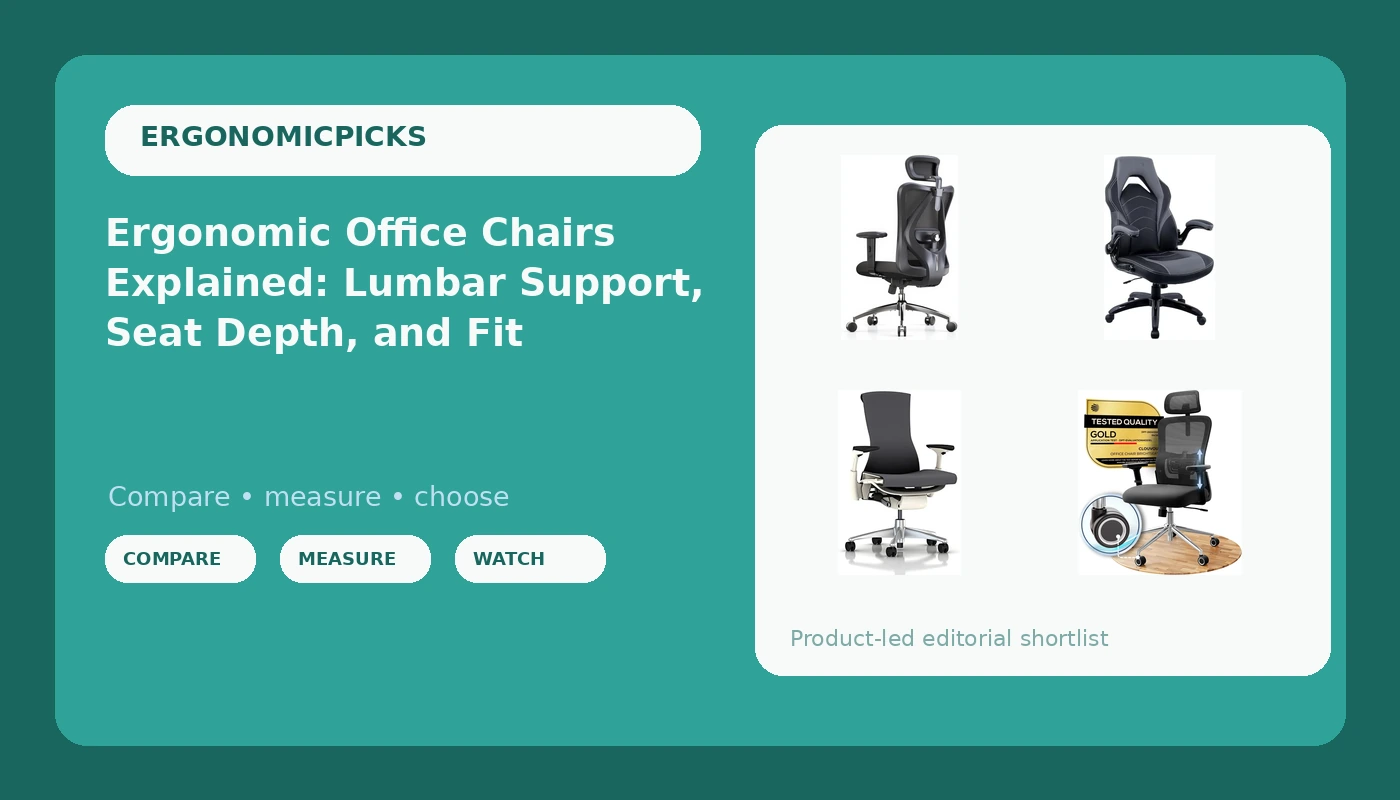
An ergonomic office chair is really just a set of adjustments, and the ones that matter are the ones you can set once and forget. That is the part almost every product page hides. You get words like ergonomic, orthopedic, and breathable stacked on top of a photo, and nothing that tells you whether the lumbar pad stays where you put it or whether the seat depth will hit the back of your knees. This explainer walks through what those adjustments actually do, how to read a listing without a showroom visit, and how four currently listed chairs differ in the way they are built and positioned. It is written for people who sit for a living and are tired of guessing.
Related: How to Set Lumbar Support So It Stays Put All Day →
Quick answer
Match the chair to your body and to your longest sitting session, then buy the adjustments you will actually use. A headrest matters if you recline. A mesh back matters if you run warm. An adjustable-height swivel base matters for almost everyone. The four chairs below represent four different answers rather than four quality tiers, and the honest way to compare them is on the listing details: lumbar adjustability, seat depth range, armrest movement, and tilt tension control. Verify each of those on the product page before you commit, because names and badges do not tell you whether a chair fits you.
4 useful options
| Model | Best fit | What stands out |
|---|---|---|
| SIHOO M18 Ergonomic Office Chair, Mesh Back Desk Chair with Headrest | Long desk days where you want a headrest | Mesh back with an included headrest; check the lumbar mechanism on the listing |
| Ergonomic Office Chair Comfy [#1 in Tests] | Buyers comparing mainstream mid-market listings | The listing title carries a test claim; read the specification block instead of the badge |
| STAPLES Emerge Vortex Gaming Chair, Adjustable Height, Swivel Black | Gaming and reclined setups | Gaming-style frame with adjustable height and a swivel base |
| Herman Miller Embody Chair, Charcoal Rhythm | Buyers planning a long-term premium purchase | Premium brand task chair in the Charcoal Rhythm fabric |
The mesh back with a headrest: SIHOO M18 Ergonomic Office Chair, Mesh Back Desk Chair with Headrest
A headrest is the most misunderstood part of a desk chair. It does nothing while you sit upright, which is most of the workday, and everything when you lean back for twenty minutes to read or take a call. If you never recline, you are paying for a feature you will not use. Mesh is the other half of this decision. Mesh is not automatically breathable, and cheap mesh has a habit of sagging long before the warranty expires, at which point it stops supporting your pelvis and starts acting like a hammock. Before you buy, put your hand behind the back panel in the store or read the return policy carefully online. A mesh back that holds tension is a good back. One that gives up in year two is a problem.
The mainstream listing: Ergonomic Office Chair Comfy [#1 in Tests]
Badges deserve a specific kind of skepticism. A number one claim in a product title usually describes one test, one configuration, and one person, and it says nothing about whether the chair will fit a 5 foot 2 inch body and a 6 foot 4 inch body equally well. The useful move is to ignore the badge and hunt for numbers. Seat height range tells you whether your feet will reach the floor. Seat depth tells you whether the front edge will press into the back of your knees. Lumbar adjustment type tells you whether the support slides up and down or actually changes its curve. If a listing will not give you those figures, that silence is information too.
The gaming style option: STAPLES Emerge Vortex Gaming Chair, Adjustable Height, Swivel Black
I review gaming chairs even though I make fun of the marketing, because a lot of people own them and the posture question is real. The bucket seat shape is the whole story. Lean back and the raised sides cradle you, which feels secure. Sit upright for eight hours of email and those same sides roll your shoulders forward and pull your head toward the screen. If your day is a mix of both, the deciding factor is how the side structure meets your shoulder blades, not the color of the stitching. For tall sitters, gaming frames often work better than they do for shorter ones, because the seat is deep and the back is tall.
The premium reference: Herman Miller Embody Chair, Charcoal Rhythm
Here is the honest framing on premium chairs. You are not buying a chair that is twice as comfortable as a mid-range one. You are buying a chair that is built to survive a decade of eight-hour days, and you are buying a parts and service ecosystem that most budget brands do not have. That math only works if you plan to keep it. If you move apartments every year or you are furnishing a first office, the premium tier is the wrong place to spend. The other thing worth knowing is that the used market for chairs like this is real, and a refurbished premium chair often makes more sense than a new mid-tier one.
Prices and availability may change. Product images, names, and retailer links are matched to verified listings. No current price, rating, stock status, or measured result is stated here without current evidence.
What ergonomic actually has to do
Strip away the vocabulary and an ergonomic chair does three jobs. It holds your lumbar curve, it keeps your feet and thighs supported so your weight is not hanging off your tailbone, and it lets your arms rest without your shoulders shrugging up toward your ears. That is it. Everything else, the stitching, the colorway, the headrest, the marketing photography, is secondary to those three jobs.
The lumbar curve is the inward curve of your lower back, and every chair claims to support it. Very few do it well. The reason is that the support has to land in the right place for your torso length, not the torso length of the model in the brochure. A pad that is welded to the backrest at a fixed height will be correct for a small slice of the population and wrong for everyone else. That is why the honest test is not whether the chair has lumbar support, but whether the lumbar support moves, and whether it stays where you put it after a few hours of pressure.
The second job, weight distribution, is where seat depth and seat height do their work. Seat depth is how far the seat goes front to back. Too long and the front edge presses into the back of your knees, which pushes you forward and flattens your lower back. Too short and your thighs dangle with no support, which loads your sit bones. Seat height determines whether your feet rest flat. A chair with the wrong height range will leave you with numb legs no matter how good the back panel is.
The third job is the one people skip, which is why I treat shoulder pain in a physical therapy practice every week. Floating elbows are the culprit. If your armrests sit below your resting elbow height, your shoulders carry the weight of your forearms all day. If they sit too high, your shoulders ride up. Armrests are not a luxury feature. They are the difference between a chair you can sit in for a full day and one you cannot.
Reading the adjustments: lumbar, seat depth, tilt tension
When you look at a listing, you are looking for four things, in this order.
Lumbar adjustment comes first. You want a support that changes position and, ideally, changes shape. A slider that moves a fixed pad up and down is better than nothing, but a mechanism that increases or decreases the depth of the curve is what actually adapts to a body. If the listing does not describe the mechanism, assume it is fixed.
Seat depth comes second, and it is the measurement most often missing. The practical rule is that you want roughly two to three fingers of space between the back of your knee and the front edge of the seat when your back is against the backrest. Some chairs adjust depth by sliding the seat pan forward and back. Others do not adjust at all, which means you are shopping for a fixed measurement that happens to match your leg length.
Tilt tension comes third. This is the resistance you feel when you lean back. A loose tilt turns into a slouch by mid-afternoon. A locked tilt keeps you rigid and stiffens your lower back. What you want is a tension control you can set so the chair follows you back and returns with you, plus a lock for when you want to stay upright for focused work.
Armrest adjustment is last but not least. Height adjustment is the minimum. If the armrests also move in and out or forward and back, you can actually park your elbows under your shoulders rather than out to the sides. Wobbly armrests that lose position under the weight of your arms are a common failure point, and they are worth checking in reviews of any chair you consider.
- Measure your seated elbow height and your knee-to-floor height before you shop.
- Confirm the seat height range covers your measurement with room to spare.
- Confirm the seat depth matches your thigh length, or that the seat pan slides.
- Check whether the lumbar support moves and whether it holds position.
- Check the armrest adjustment directions, not just whether armrests exist.
Practical guidance
- Sit in the chair for a full workday before you decide, not ten minutes in a showroom. Hour six is the review.
- Bring your own numbers to the listing: seat height range, seat depth, and elbow height are the three that decide fit.
- Treat mesh as a tension question, not a comfort claim. If the back panel sags under your hand, it will sag under your body.
- Budget for the chair you will still be sitting in three years from now, and price the warranty terms into that math.
- If a listing will not state its adjustment ranges, assume the adjustment does not exist and buy accordingly.
Which option should you choose?
Choose the SIHOO M18 Ergonomic Office Chair, Mesh Back Desk Chair with Headrest when you want a mesh back and you actually use a headrest, since that combination is the point of the listing. Choose the Ergonomic Office Chair Comfy [#1 in Tests] when you are comparing mid-market listings on specification rather than badges and you are willing to read the numbers yourself. Choose the STAPLES Emerge Vortex Gaming Chair, Adjustable Height, Swivel Black when your sitting is mostly reclined gaming and you like the bucket seat posture. Choose the Herman Miller Embody Chair, Charcoal Rhythm when you are making a long-term purchase and want a premium task chair you intend to keep for years.
One caveat applies to all four. No chair is one size fits all, and no listing title can tell you whether a chair fits your body. The adjustment ranges, the seat depth, and the armrest movement are what decide that, and they have to be checked against your own measurements. If a chair cannot be returned, treat that as a real cost, because fit is the one thing you cannot fix after delivery.
The bottom line
An ergonomic office chair is a fit problem before it is a price problem. Get the lumbar support, seat depth, and armrest position right and a mid-market chair will serve you for years. Get them wrong and a premium chair will still leave you shifting around by mid-afternoon. Use the four listings here as four different answers: a mesh back with a headrest, a mainstream mid-market option, a gaming frame, and a premium long-term chair. Then check the adjustment ranges on the listing, compare them to your own measurements, and buy the one that matches your body rather than the one with the loudest badge.