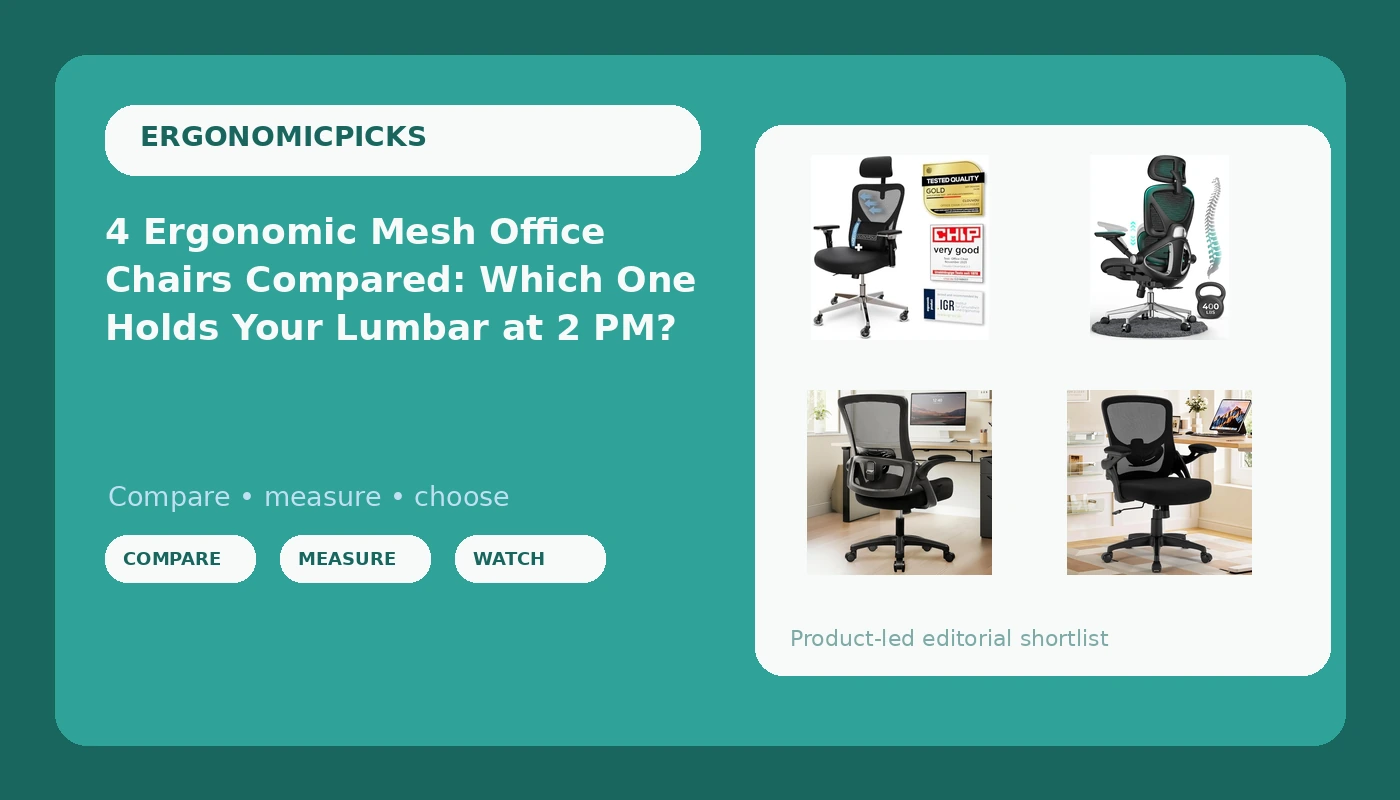
I have spent sixteen years as a physical therapist, the last eight of them consulting for offices that keep buying chairs nobody can sit in for eight hours. That is why I care so much about ergonomic mesh office chairs: the mesh is the easy part, and the adjustments are where the money goes. Every chair on this page claims adjustable lumbar support. Almost none of them tell you whether that support holds its position after lunch, and that single question is the difference between a chair you keep for five years and a chair you replace in eighteen months.
For most people reading this, the CAPOT Ergonomic Mesh Office Chair is where I would start, because it is the only chair in this group that documents four separate adjustments that actually change your posture: 4D flip-up armrests, a three-level tilt backrest, a 3D headrest, and an adjustable lumbar support, all sitting on a 400 lb rated frame.
Here is how the four compare on the things I actually ask about. Prices move constantly on Amazon, so trust the listing, not a number someone screenshotted last spring.
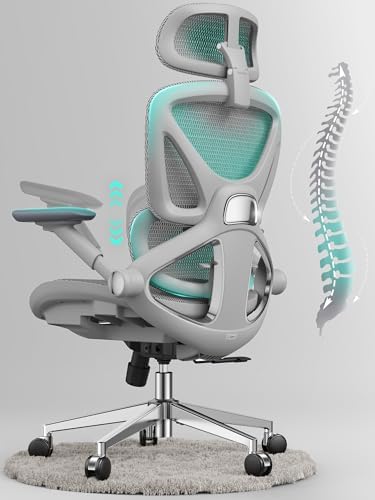
CAPOT Ergonomic Mesh Office Chair
Four adjustments that change posture, plus a 400 lb rating and PU wheels
Largest footprint here, and the heaviest frame of the four
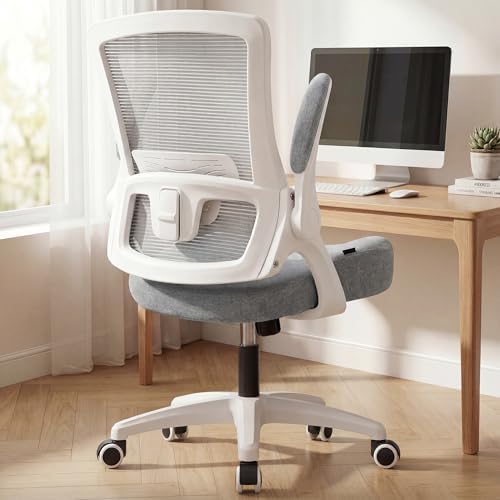
NEO CHAIR High Back Mesh Office Chair
High back with adjustable lumbar for the smallest outlay in this group
Fixed armrests, no headrest, fewer lock positions
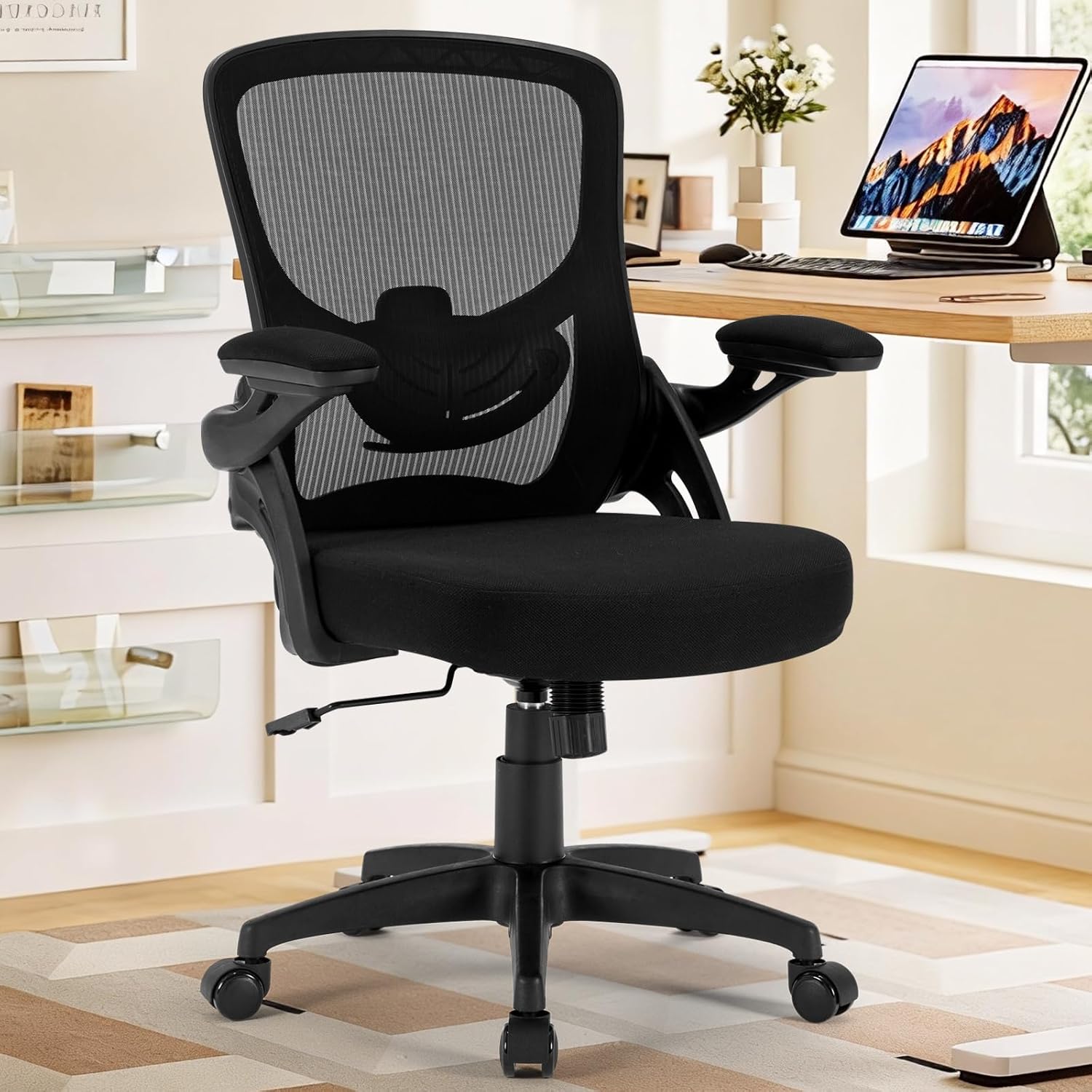
Office Chair with Flip-up Armrests (Mid Back)
Flip-up arms tuck under a shallow desk, mid back suits shorter torsos
Back is too short for tall sitters, armrests adjust in one direction
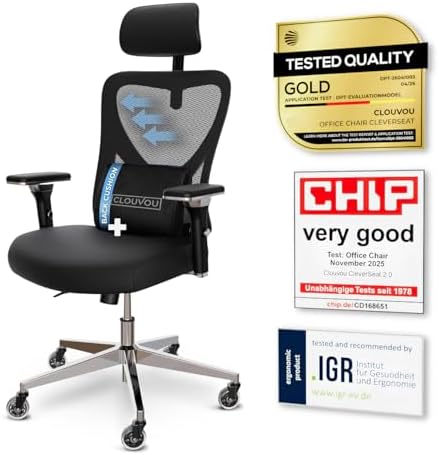
Ergonomic Office Chair Comfy
Soft, forgiving seat that people describe as comfortable in the first hour
Fewer documented adjustments than the CAPOT for a similar footprint
Prices and availability were captured from Amazon Creators API and may change.
What actually matters in an ergonomic mesh office chair
Show me your lumbar curve after hour six. That is the review. Everything else, the color, the caster style, the word "ergonomic" printed on the box, is decoration.
Four things decide whether a chair works for a specific body:
Does the lumbar support adjust in place, or does it just slide? A pad that slides up and down the back frame is close to useless, because it moves the moment you lean back. What you want is a support that locks at a height and holds there, so it stays against the inward curve of your lower back when you shift your weight. This is the test I run at two in the afternoon on a Tuesday, not the test in the showroom.
Is the seat depth right for your femur? Too long, and the front edge presses behind your knees and cuts off circulation. Too short, and your thighs dangle, which loads the hamstrings and tips the pelvis backward. Seat depth is the adjustment most budget chairs do not offer at all, which is why a chair that fits your height beats a chair with a longer feature list.
Do the armrests hold position? Floating elbows are how I get shoulder pain referrals every week. Flip-up arms are a compromise: excellent for tucking a chair under a shallow desk, but usually fixed in height and width. Four-direction arms cost more and are worth it if you type all day.
What is the tilt doing? A backrest that only locks upright forces you into one posture for eight hours. Multiple lock positions or a tension control let you change the load on your spine without changing chairs, and alternating posture is the single most useful thing you can do for a lower back that is already irritated.
CAPOT Ergonomic Mesh Office Chair: the most adjustable of the four
The CAPOT is the only chair here that reads like someone wrote the spec sheet with a tape measure in hand. A high back with an adjustable lumbar support covers more of the thoracic spine, which matters if you are tall or long-waisted. The 4D flip-up arms are the standout feature: four directions of adjustment means you set height, width, depth, and angle, then flip them out of the way when you want to pull close to a keyboard. Most flip-up arms on budget chairs are height-only, so this is a genuine step up rather than a bullet point.
The three-level tilt backrest is the other feature I would pay for. Three lock positions let you alternate between upright for typing and reclined for reading, and that alternation is what keeps a disc from spending the whole day under the same load.
The 3D headrest and PU wheels are the details that separate a chair built for long desk sessions from a chair built for a showroom floor. A headrest only helps if it adjusts enough to sit under the base of your skull rather than pushing your chin forward. PU wheels roll quietly on hardwood instead of chewing it up, which matters if you rent.
Where it loses: this is the most expensive chair in the group, the largest physically, and the 400 lb rating means a heavier frame underneath. If you are five foot two working at a slim writing desk, the CAPOT is more chair than you need, and the flip-up arms will not save you the space the seat pan takes.
NEO CHAIR High Back Mesh Office Chair: the value high back
If your budget is the hard constraint and your back is the reason you are shopping, the NEO CHAIR is the one I would point you toward. It is a high back with an adjustable lumbar support, which is the combination that matters most for anyone whose pain sits in the lower back. The high back gives you somewhere to rest your thoracic spine when you recline, and the mesh keeps air moving across your back so you are not peeling yourself off the upholstery at four o'clock.
The honest limitations: the armrests are fixed, so if your shoulders roll forward at the end of a long day, you will feel it. There is no headrest, which is fine for typing and less fine if you recline to read. And a high back chair at this end of the market usually means the frame flexes a little more than a heavier chair does. That is not a defect, it is a trade you are making knowingly.
What I would tell a client: buy this one if the alternative is a waiting room chair with a stamped "ergonomic" label and no lumbar adjustment at all. That is not a small upgrade. It is the difference between support and no support.
Office Chair with Flip-up Armrests: the small-space mid back
This is the chair for a corner of a bedroom, a shallow desk against a wall, or anyone who needs to push the chair fully under the desk at the end of the day. Flip-up armrests are the entire reason this chair exists in the lineup, and they do that job well. The mid back keeps the visual footprint small, the mesh back breathes, and the adjustable lumbar support means you are not giving up the one feature I refuse to compromise on. The swivel base and rolling casters make it usable for a shared desk where two people sit at different times.
The trade-off is height. A mid back stops below the shoulder blades, which is fine for a shorter torso and noticeably less supportive for someone over about six feet. The lumbar support adjusts, but the range is shorter than the CAPOT's, so if your lower back pain sits high, this chair may not reach it. The flip-up arms are also not four-direction arms. They get out of your way, they do not follow your elbows.
Buy it if space is the constraint and you are average height or shorter. Skip it if you are tall, or if you already know your pain lives between the shoulder blades.
Ergonomic Office Chair Comfy: the one with the loudest name
The name tells you what the design prioritizes, and it is not subtle. This is the chair people describe as comfortable in the first hour, and comfort in the first hour is real, it is just not the same thing as support in the sixth. The seat is forgiving, the mesh back breathes, and the overall package reads as an executive chair that happens to be mesh rather than a task chair that happens to look nice.
Where I push back: "comfy" is not a specification. What I want to know is whether the lumbar support locks, how far the seat depth goes, and whether the armrests hold their position under load. This chair documents fewer adjustments than the CAPOT at a similar footprint, so if your back is already talking to you, the CAPOT is the better buy. If your back is fine and you want a chair that feels good to sit down in, this one earns its name.
The other thing to watch on any padded seat: soft foam compresses over time, and a seat that feels plush in month one can feel flat by month twenty. Mesh back plus a padded seat is a reasonable combination, but the padding is the part that ages first.
The trade-offs nobody puts in the bullet list
Weight ratings are structural, not marketing. A 400 lb rated chair like the CAPOT uses a heavier frame, a stronger gas lift, and a wider base. If you are under 200 lb, you are paying for headroom you may not need. If you are over 250 lb, that rating is the first thing you should look at, because the gas lift is the part that dies first on cheap chairs, usually around month fourteen.
Mesh is not automatically breathable. Cheap mesh sags. When it sags, the seat becomes a hammock for your tailbone, and a hammock is the opposite of support. You cannot judge mesh from a photograph, which is why the warranty and the weight rating tell you more than the weave pattern.
Flip-up arms are a space solution, not an ergonomic one. They solve a real problem, and they are not a substitute for height and width adjustment. If you type eight hours a day, four-direction arms are the better investment.
A headrest only works if it adjusts. A fixed headrest pushes your chin forward and makes you crane your neck. The 3D headrest on the CAPOT is the only one in this group that gives you a fighting chance of setting it correctly.
Every chair here is a five-year purchase or it is not a purchase at all. The chair that dies in eighteen months was never cheap, no matter what the listing said.
Match the chair to your body, not to the ranking
Tell me your height, your pain, and your budget. Everything else is marketing.
If you are tall, over six feet, or long-waisted: high back, and a headrest that adjusts. The CAPOT is the pick, with the NEO CHAIR as the budget version.
If you are average height with lower back pain: adjustable lumbar that locks, plus multiple tilt positions. CAPOT first, NEO CHAIR if the budget is tight.
If you are shorter than about five foot four: a mid back chair is not a compromise, it is a fit. The chair with flip-up armrests keeps the back where your back actually is, and the smaller seat pan will not push behind your knees.
If you work in a small space: flip-up arms, every time. The mid back chair and the CAPOT both give you that.
If you want a chair that feels good and your back is not complaining yet: the Comfy is a legitimate choice. Just go in knowing you are buying comfort, not adjustability.
No chair is one size fits all. Anyone who tells you otherwise is selling something.
What I would check before you order
Measure your desk height and your popliteal height, which is the distance from the floor to the crease behind your knee. They should roughly match, or the chair needs a footrest. Then measure the depth of the space under your desk and compare it to the seat depth of the chair you are considering, because a chair that will not tuck in is a chair you will stop using.
Check the return window and the warranty. A chair is a five-year purchase, and the warranty is the manufacturer telling you how long they expect it to last. Then check the armrest adjustment range against your own shoulder width, because armrests that are too narrow push your shoulders up and armrests that are too wide let your elbows float.
Finally, give any new chair two weeks before you decide. The first three days are noise. What you want to know is how it feels at two in the afternoon on a Tuesday in week three.
Bottom line
The CAPOT Ergonomic Mesh Office Chair is the most adjustable chair in this group and the one I would prescribe most often, because 4D arms, a three-level tilt, a 3D headrest, and a lumbar support that adjusts all point at the same goal: keeping your posture changeable through a long day. The NEO CHAIR is the value high back for a tight budget. The flip-up armrest mid back is the right answer for small spaces and shorter frames. The Comfy is the comfort-first option, and it is honest about that.
Pick the one whose adjustments match your body. That is the whole test.