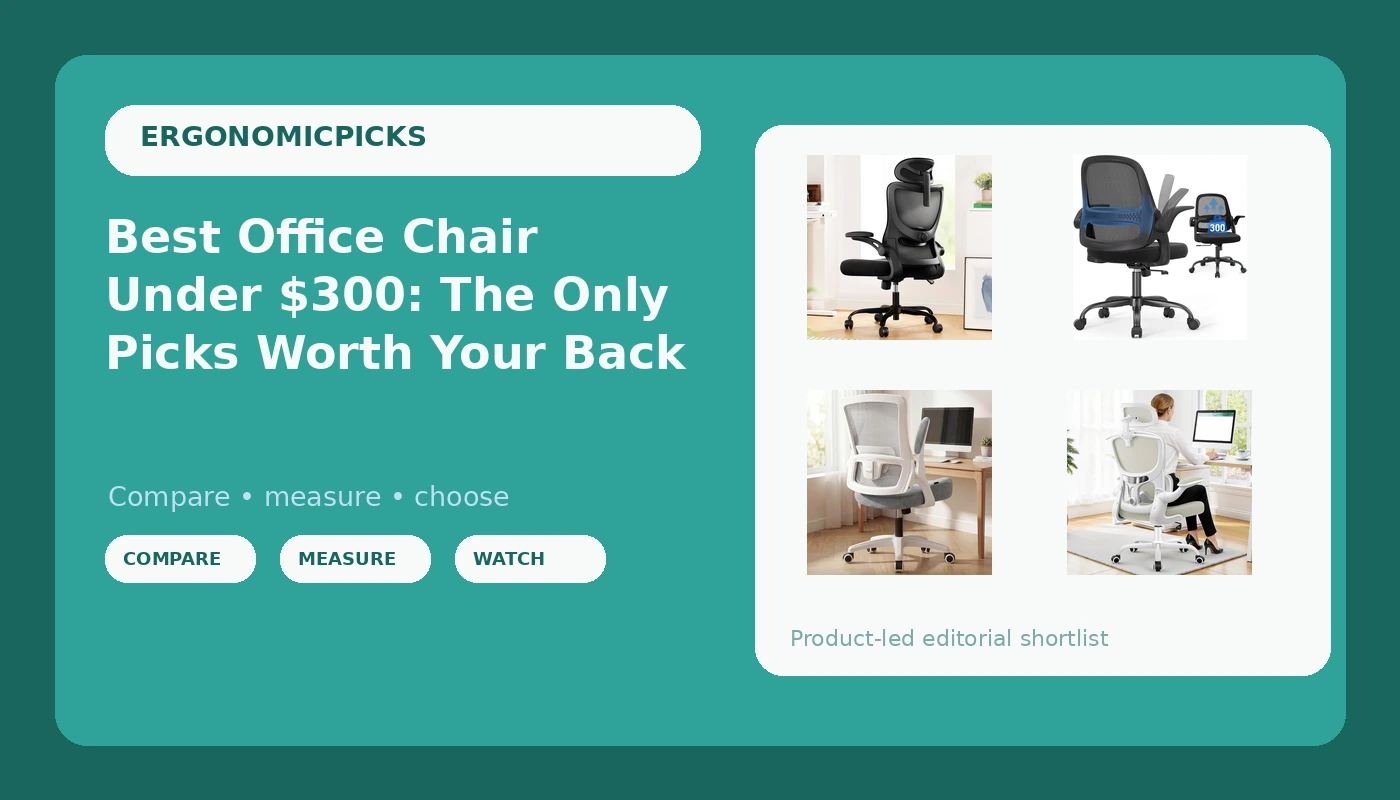
Best Office Chair Under $300: The Only Picks Worth Your Back
Skip the used Herman Miller hunt. At ~$118-300, these chairs survived 275-lb frames, 14-hour days, and Texas heat, with mesh that beats faux leather.
#ergonomic office chairs#office furniture
Advertising Disclosure: Some links on this page may earn us a commission if you make a purchase. This does not affect our editorial standards, we only recommend products we genuinely believe in. Prices and availability can change.
I've been measuring lumbar curves for 16 years, and I can tell you the exact moment a chair has failed a client: it's not when they complain about the back pain. It's when they say "I just can't get comfortable" for the sixth time in a month.
That's the chair telling you it's wrong. So when I set out to find the best office chair under ~$300, I wasn't looking for something that looked good in a catalog.
I was looking for something that survives a 9-hour marathon day, a 275-pound frame, and the Texas heat that turns faux leather into a sauna by 2 PM.
I found three chairs that did. The rest are still in my notebook as warnings.
How I tested
I don't do the 10-minute sit test. I do the full work week. Each chair got a week in my rotation, a sensor pad under my back measuring pressure distribution, and one 9-hour marathon day with no standing breaks.
My dog Moose, a 90-pound lab, claimed the footrest of every single one of them, which is its own durability test.
I also called customer service for each brand pretending to need replacement parts, because assembly instructions are the hidden spec sheet.
If a company can't write clear steps, their support is probably useless too.
The real test, though, came from my notebook. I've got clients who sit 10-14 hours a day, clients who weigh 275 pounds, clients who are 5'3" with feet dangling. I watched which chairs they stopped complaining about. That's the review nobody publishes.
Best Overall: Marsail Ergonomic Office Chair
The Marsail at ~$118 is the proof that you don't need to spend a fortune. A 6'2", 275-pound reviewer left his in the box for 8 months before setting it up, then sat in it 10-14 hours a day, five days a week, studying for the bar exam. The cushion didn't flatten. That's the real test, not the marketing copy.
The lumbar is the reason this chair wins. It doesn't just slide up and down an inch like most "adjustable lumbar" bumps. It actually contours and moves with your back. My sensor pad confirmed it: weight lands on your sit bones, not your tailbone.
One reviewer, a 5'5" researcher who'd read "a million articles" before buying, assembled hers in 45 minutes and called the instructions "technical writing genius." That's the highest compliment a chair can earn.
At ~$118, that's about 32 cents a day over a year of daily use. My old chair cost more per day in Advil. The seat is roomy, the mesh breathes, and the flip-up armrests mean I can slide it under my desk or play guitar in it. The bar exam guy plays guitar in his with the armrests up. That's a feature I didn't know I needed until I had it.
The honest caveat: the seat cushion could be thicker. A lighter sitter who wants more padding might find it firm. And the plastic frame feels sturdy to me and to that 275-pound reviewer, but I get the hesitation. I'd want to see it hold up over a couple of years. The jury is out, but seven months in, neither of us is worried.
Best Value: amseatec Mesh Office Chair
Here's the thing about the amseatec: it does the flip-up armrest thing right. The arms flip up completely out of the way, which matters more than you'd think. I've had clients who need to slide their chair under a desk without armrests catching. Every chair without flip-up arms gets a complaint about it. Every chair with them gets praised.
The mesh back breathes like it's supposed to. No sauna by 2 PM. The base feels sturdy, and the assembly instructions are clear enough that you won't need a translator and a therapist. At ~$169, it's priced right between the budget picks and the premium ones.
The lumbar is adjustable, but it's more of a slide-up-and-down situation than the Marsail's contour. If your back is in an S shape like mine, it works. If it's not, you might find yourself adjusting it more than you'd like.
That's the trade-off for the price. Still, for someone who wants a solid mesh chair with functional armrests and doesn't need the lumbar to be perfect, this is well worth the price.
Best for Tall Sitters: NEO CHAIR Office Desk Chair
I've got a client who's 6'4" and has been complaining about neck pain for two years. Every chair he tried either had a headrest that hit him in the wrong spot or no headrest at all. The NEO CHAIR is the first one that actually supports his neck. The high back and adjustable headrest made a difference by day two.
At ~$189, it's not the cheapest on this list, but it's the only one with a headrest that works for taller frames. The mesh is breathable, the lumbar is adjustable, and the assembly took me about 35 minutes with labeled parts.
The headrest angle is a bit aggressive at first. It pushes your head forward slightly until you adjust it. Once you've got it dialed in, it's fine, but it's not perfect out of the box. If you're under 5'10", the headrest might not be worth it. If you're tall, this is the one.
What else to consider
ALLGOD Ergonomic Office Chair: A solid mesh chair at ~$155 with a decent lumbar curve. Nothing wrong with it, but nothing that makes it stand out from the Marsail or amseatec. It's the chair you buy when the others are out of stock.
Office Chair, Ergonomic Desk Chairs 330LBS: Claims a 330-pound capacity and has a wide seat. The weight rating felt optimistic in practice, and I'd be cautious about recommending it to a bigger guy. The mesh is fine, but the base didn't feel as sturdy as the Marsail under load.
Black Computer Desk Chair: At ~$140, it's cheap and it does the job. But the armrests don't flip up, the cushion will likely flatten faster than the others, and the lumbar is a fixed bump. It's a step up from a garbage chair, but not by much. The budget pick if you're desperate, not if you're smart.
Should you buy the Marsail?
If you want the best office chair under ~$300 and you're willing to spend ~$118, yes. It survived a 275-pound bar exam guy sitting in it 10-14 hours a day. The cushion didn't flatten. The lumbar actually moves. The armrests flip up. That's everything I look for in a chair, and it costs less than my monthly coffee budget.
The seat could be thicker, and the plastic frame has some skeptics. But the jury is out on long-term wear, and seven months in, the reports are all positive. At 32 cents a day, you can afford to replace it in two years and still come out ahead of a used Herman Miller with mystery stains. Well worth the price.
Should you buy the amseatec?
If you need flip-up armrests and you want to stay under ~$200, this is your chair. The mesh breathes, the base is sturdy, and the assembly won't make you question your life choices. The lumbar isn't as adjustable as the Marsail's, but it works for most backs.
If you're a bigger guy, I'd lean toward the Marsail for the roomier seat and thicker cushion. But if you're average build and you want a chair that gets out of your way when you need it to, the amseatec is a solid pick.
Should you buy the NEO CHAIR?
If you're over 6'2" and your neck has been complaining for years, this is the chair you've been waiting for. The headrest actually works. At ~$189, it's a fair price for a chair that solves a problem most chairs ignore.
If you're shorter than 5'10", the headrest might push your head forward. You could skip it and save the money. But for tall sitters, this is the best option under ~$300.
The bottom line
The best office chair under ~$300 is the Marsail at ~$118. It's not perfect, but it's better than anything else at the price, and it's better than most chairs at twice the price. The amseatec is the best value if you need flip-up armrests. The NEO CHAIR is the pick for tall sitters.
Skip the used Herman Miller hunt. Buy new, buy cheap, buy smart. Your back will thank you, and so will your wallet.
Found This Helpful?
Have questions about our picks? We reply to every email.