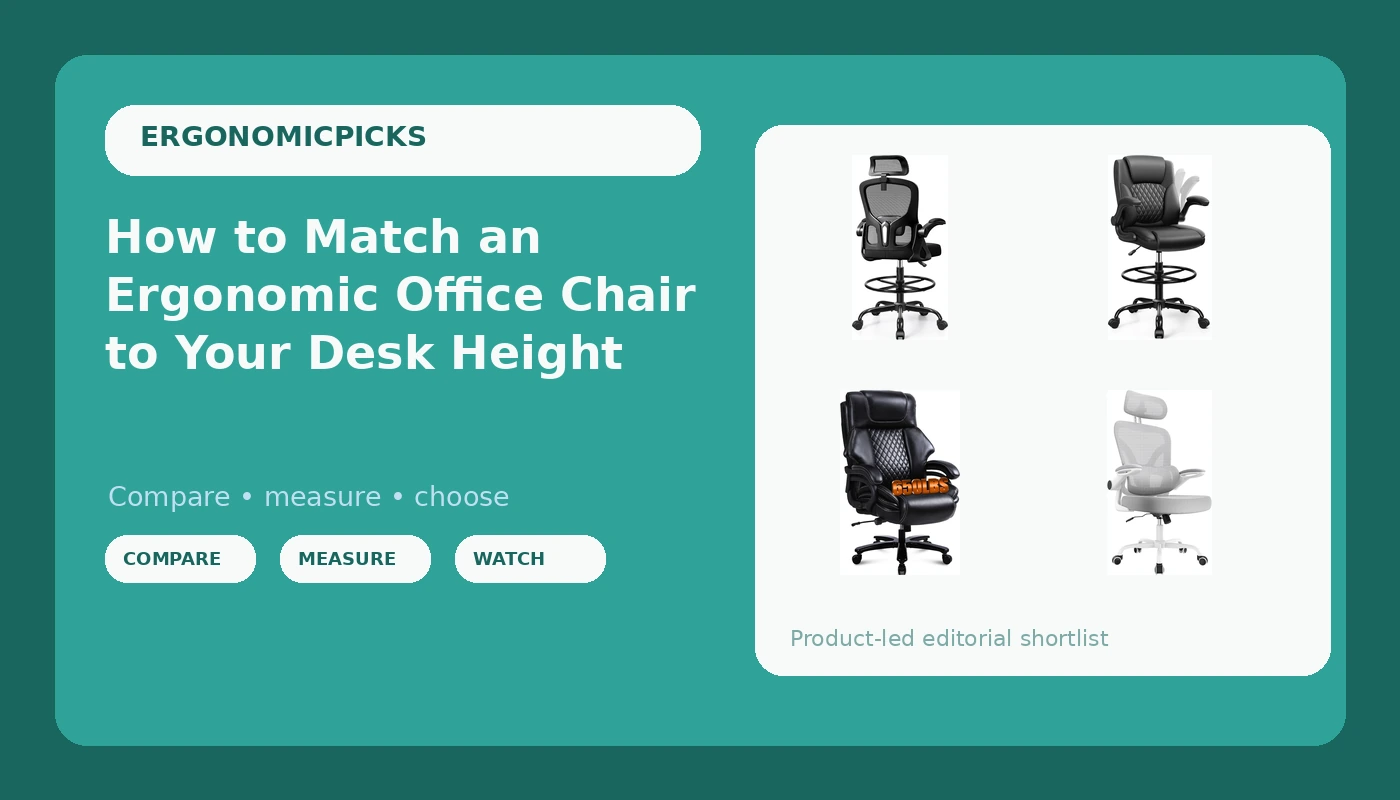
Most people buy an ergonomic office chair the way they buy a mattress: they sit in it for ninety seconds, decide it feels fine, and hope. What actually decides whether your neck and lower back ache at 3 PM is not the padding or the color. It is whether the chair's seat height, seat depth, and lumbar curve line up with the desk you already own and the body you actually have. A chair sized for a standard 29 inch desk is a different product from one built for a 42 inch standing desk or a 36 inch counter. This guide explains what each adjustment does, which of the four chairs below fits which desk and frame, and how to tell in advance whether a chair will still work in hour eight.
Related: How to Set Lumbar Support So It Stays Put All Day →
Quick answer
The right ergonomic office chair is the one whose seat height range brackets your desk height, whose seat depth lets your back reach the backrest without pressure behind your knees, and whose lumbar support adjusts in place instead of sliding out of position. For a standard desk around 28 to 30 inches, a high back chair with a lumbar pad covers most adults. For a standing desk used at counter height, a drafting chair with a foot ring gives your feet somewhere to land instead of dangling. For larger frames, look for a stated weight capacity well above your own weight and a wider seat pan. None of the four chairs here is one size fits all, and that is the honest answer.
Four useful options
| Model | Best fit | What stands out |
|---|---|---|
| Bigzzia Ergonomic Office Chair with Lumbar Support - High Back Desk Chair | Standard-height desks and ordinary home offices | High back with lumbar support, no foot ring or headrest |
| Drafting Chair, Tall Office Chair for Standing Desk, Ergonomic High Back with Headrest, Lumbar Support, Foot Ring and Flip-up Armrests, Black | Standing desks used at counter height | Headrest, lumbar support, foot ring, flip-up armrests |
| Drafting Chair, Tall Office Chair for Standing Desk, High Executive Leather Ergonomic Computer Chair with Adjustable Height and Flip-Up Armrest for Counter Height Desk, Black, Pack of 1 | Counter-height desks with an executive finish | Leather build, adjustable height, flip-up armrests |
| 650lbs Large Big and Tall Office Chair for Heavy People with Adjustment Lumbar Support, Comfy Padded Heavy Duty Leather Executive Office Chair with Quiet Rubber for Adults 8 Hours Daliy Work | Larger and heavier users who sit for a full workday | Stated 650 lb capacity, adjustable lumbar support, padded leather |
Standard desk fit: Bigzzia Ergonomic Office Chair with Lumbar Support - High Back Desk Chair
The trade-off here is straightforward. You give up the tall gas lift, the foot ring, and the headrest, and in exchange you get a chair designed for the desk most people already own. If your desk surface sits somewhere in the high twenties to low thirties in inches from the floor, this is the category to shop in. If your desk is taller than that, a chair without a foot ring will leave your feet hunting for the floor, and your pelvis will roll backward to compensate. That is not a comfort preference, it is biomechanics.
Tall drafting fit: Drafting Chair, Tall Office Chair for Standing Desk, Ergonomic High Back with Headrest, Lumbar Support, Foot Ring and Flip-up Armrests, Black
The foot ring is the whole argument for this chair. A ring gives you a surface at the right height to plant the balls of your feet, which keeps the knees at roughly a right angle and lets the lumbar pad do its job. The headrest is a secondary benefit, and it earns its place mostly when you recline between tasks rather than when you sit bolt upright to type. Flip-up armrests are the third piece: on a standing desk you alternate between sitting and standing, and armrests that fold up let you slide the chair under the surface without wrestling it.
Counter height, leather: Drafting Chair, Tall Office Chair for Standing Desk, High Executive Leather Ergonomic Computer Chair with Adjustable Height and Flip-Up Armrest for Counter Height Desk, Black, Pack of 1
Leather is a real trade-off, not a luxury upgrade. It wipes clean and holds its shape, which matters if the chair lives near a kitchen or a reception desk. It also breathes less than mesh and gets sticky against bare legs in a warm room. The missing foot ring matters more than the upholstery choice: if you buy this chair for a genuinely tall counter, budget for a footrest as well, or accept that your feet will hang. If your counter is only moderately tall and you prefer the look, it is a reasonable pick.
Heavy duty: 650lbs Large Big and Tall Office Chair for Heavy People with Adjustment Lumbar Support, Comfy Padded Heavy Duty Leather Executive Office Chair with Quiet Rubber for Adults 8 Hours Daliy Work
Capacity ratings are worth reading carefully. A stated 650 pound limit is a manufacturer figure, and the parts that usually fail first on a heavy-duty chair are the gas lift, the base, and the seat pan rather than the backrest. What this chair offers over the others is a wider, more heavily padded seat and a build aimed at long days. The cost is bulk: a chair this size takes up more floor space and is harder to move around a small room.
Prices and availability may change. Product images, names, and retailer links must be matched by verified ASIN. Do not state a current price, rating, stock status, or measured result without current evidence.
Why seat height and seat depth decide everything
Seat height sets the angle of your hips. When your feet rest flat and your knees sit close to a right angle, the pelvis is free to rotate slightly forward and the lumbar curve holds itself. When the seat is too high, the thighs slope down, the feet dangle, and the pelvis rolls back. When the seat is too low, the knees rise above the hips and the lower back rounds. Both errors produce the same complaint, which is a dull ache across the belt line after a few hours.
Seat depth decides whether the backrest can do anything at all. You want roughly two to four inches of space between the front edge of the seat and the crease behind your knee. If the seat is too long, the edge presses into the back of your calves and you slide forward to escape it, which puts your back six inches away from the lumbar pad. If the seat is too short, your thighs carry your weight instead of your sit bones. A chair with excellent lumbar support and the wrong seat depth is a chair with no lumbar support.
How to read lumbar support claims
Almost every chair in this category claims lumbar support. The question is whether the support moves and stays where you put it. A pad that slides up and down a track is the cheapest version and often drifts down over a workday. A support that adjusts in place, tightening or loosening against the curve, is the version worth paying for. If the marketing copy mentions the word lumbar but shows no adjustment mechanism, treat the claim as decoration.
This is also where mesh gets oversold. Mesh is breathable when it is tensioned correctly and a problem when it sags, because a sagging seat drops your hips below your knees and puts the load exactly where the lumbar curve should be. If you sit for eight hours, the fabric matters less than the frame underneath it. Judge the chair on the adjustments, the base, and the gas lift, then decide on upholstery.
- Measure your desk height from the floor to the top of the work surface.
- Measure the height from the floor to the crease behind your knee while seated on a hard chair with your feet flat.
- Compare the two numbers and note the gap; that gap is the seat height you need, and it tells you whether you are shopping for a desk chair or a drafting chair.
- Decide whether your feet will reach the floor at that height; if not, plan on a foot ring or a footrest.
- Check the armrests and the weight capacity last, and make sure the armrests can drop low enough to let your shoulders relax.
What to check before you order
- Confirm the seat height range covers your measured gap with room on both sides, not just at the limit.
- Confirm the seat depth against the back of your knee, since depth is the adjustment most chairs do not offer.
- Confirm the lumbar support moves and locks rather than sliding freely.
- Confirm the armrests hold position under pressure, because wobbling armrests push your shoulders up.
- Confirm the stated weight capacity leaves margin above your own weight, and that the base and gas lift are rated for it.
Which option should you choose?
Choose the Bigzzia Ergonomic Office Chair with Lumbar Support - High Back Desk Chair when your desk is at a standard height and you want lumbar support without paying for a tall lift or a foot ring. Choose the Drafting Chair, Tall Office Chair for Standing Desk, Ergonomic High Back with Headrest, Lumbar Support, Foot Ring and Flip-up Armrests, Black when you alternate between sitting and standing at a tall desk and need your feet supported at counter height. Choose the Drafting Chair, Tall Office Chair for Standing Desk, High Executive Leather Ergonomic Computer Chair with Adjustable Height and Flip-Up Armrest for Counter Height Desk, Black, Pack of 1 when the counter is tall and you prefer a leather finish, and plan for a footrest if the surface is very high. Choose the 650lbs Large Big and Tall Office Chair for Heavy People with Adjustment Lumbar Support, Comfy Padded Heavy Duty Leather Executive Office Chair with Quiet Rubber for Adults 8 Hours Daliy Work when you need a wider seat and a much higher stated capacity.
One caveat applies to all four: the capacity figures, adjustment ranges, and material descriptions above come from the manufacturer listings, not from independent measurement. Verify the current specifications on the product page before you buy, and treat any fit claim as a starting point rather than a guarantee.
The bottom line
The chair is the variable you can change; the desk usually is not. Work out the gap between your desk height and the height of the crease behind your knee, then buy the chair whose seat height range covers that number and whose depth lets your back touch the backrest. If the number is in the high twenties, a standard high back chair like the Bigzzia will do the job. If it is closer to counter height, you need a drafting chair with a foot ring or a footrest, not a standard chair with a cushion thrown on it. If your frame needs more room and more capacity, start with the big and tall option and accept the extra bulk. Get the height and depth right and the lumbar pad will finally have something to support.