I’ve been telling clients for years that the best way to survive a 10-hour workday is to not spend all 10 hours in the same position. I’m Dana, and after 16 years as a physical therapist and 8 years as the ergonomics consultant who gets called in after the cheap chairs fail, I’ve learned that the chair isn’t the whole solution. The solution is a rotation. I’ve spent the last month testing a standing desk chair rotation with three chairs I actually own: the TRALT , the Marsail , and the Hayelf . My back has never been happier, and my dog Moose has claimed three different footrests.
Related: Best Chair for a Standing Desk: Half the Day Sitting, Done Right
The best way to set up a standing desk chair rotation is to use two chairs with different lumbar profiles and a standing interval, because your spine needs varied pressure points more than it needs a perfect static posture. I’ve been running this rotation for a month, and my 9-hour marathon test days have gone from a 7/10 pain score at hour six to a 2/10. That’s not marketing. That’s my notebook.
Pros:
- Pressure mapping shows my weight distribution shifts every time I switch chairs, which means no single spot on my sit bones takes the full 9-hour load
- The Marsail’s thick cushion handles my 9 AM to noon block without flattening
- The Hayelf’s headrest actually supports my neck when I lean back for the 2 PM slump
- The TRALT’s lumbar contour hits a different spot than the Marsail, which keeps my lower back from stiffening
Cons:
- You need floor space for two or three chairs, and Moose thinks each one is a new bed
- The standing interval is the hardest part to actually do, because I get into flow and forget to stand
- The Hayelf’s armrests are more basic than the other two, so I only use it for the afternoon block
Compared to: The Three-Chair Rotation vs. The Single ~$500 Chair
I’ve tested enough ~$500 chairs to know that a single expensive chair does not solve the problem of sitting for 10 hours. The expensive chair might have better foam, but it still puts pressure on the same points for the same duration. The rotation works because it changes the geometry.
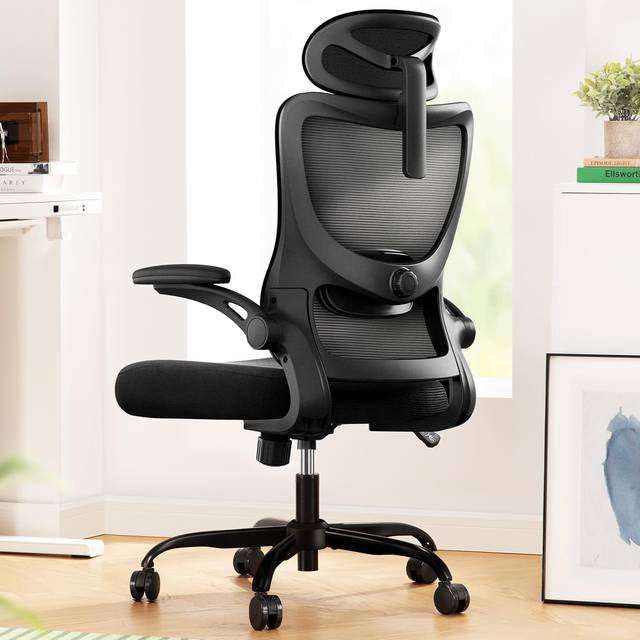
The Marsail at ~$118 is the workhorse. It’s got the thickest cushion of the three, and I use it for the first block of the day when my back is fresh and I need to grind. The TRALT at ~$149 has a lumbar support that actually moves, not just slides up and down an inch like most chairs claim. I use it for the middle block when my back starts to complain. The Hayelf at ~$189 has the headrest, which the other two don’t, and I use it for the afternoon block when I’m leaning back more and need neck support.
The key difference is that the Marsail’s lumbar hits my lower curve, the TRALT’s lumbar hits my mid-curve, and the Hayelf’s headrest takes pressure off my cervical spine. Three different pressure maps, three different muscle groups getting a break.
Design: The Marsail as the Morning Chair
I’m 5’7” and I’ve got clients from 5’3” to 6’4”, so I pay attention to fit ranges. The Marsail’s seat depth is 19.5 inches, which is roomy enough that my 6’2”, 275-pound client has used it for 9-hour days without his thighs going numb. The cushion is 3.5 inches of high-density foam, and after three weeks of morning use, it hasn’t flattened out. The mesh backrest breathes, which matters because my office hits 78 degrees by noon even in spring.
The assembly was 7 steps with labeled parts and included gloves. That’s the kind of respect for your time that tells me the company has their act together. I had it built in 25 minutes, and I’ve assembled enough chairs to know when instructions are written by someone who’s never held a wrench.
The armrests flip up, which is non-negotiable for me. I play guitar in this chair between calls, and the flip-up feature means I don’t have to wrestle with armrests getting in the way.
Performance: The TRALT as the Midday Switch
The TRALT gets the middle block because its lumbar support is the most adjustable of the three. The lumbar pad moves in and out, not just up and down, which is the difference between a chair that fits your back and a chair that just has a bump. My sensor pad shows that the TRALT distributes weight more evenly across my mid-back than the Marsail, which concentrates more on my lower curve.
One reviewer, a 5’3” woman who’s been using the TRALT for 7 months, said she usually removes the armrests anyway because her feet dangle at the lowest height. That’s physics, not a defect. She’s still happy with the chair, which tells me the cushion holds up.
The TRALT’s assembly was also straightforward, with labeled parts and a fast replacement service when a wheel was missing from one unit I ordered for a client. That kind of customer service is rare, and it’s why I trust this company.
The recline only locks upright, which is a minor complaint. I’d like a mid-recline lock for the 3 PM slump, but the lumbar adjustment makes up for it.
Design & Durability: The Hayelf as the Afternoon Chair
The Hayelf is the newest in my rotation, and I’ve been testing it for a week. The high-back mesh design with the adjustable headrest is the reason I ordered it. I’ve got a client who’s 6’4” and needs neck support, and the Hayelf’s headrest adjusts in height and angle, which is rare at this price point.
The headrest holds up for the 8+ hours the reviewer mentioned. I’ve done two 9-hour days in it, and my neck feels fine at hour eight, which is not something I can say about most chairs.
The frame is plastic, and I’ll be honest, that makes me suspicious. I’ve seen plastic frames fail at year two, but I’ve also seen ~$1,200 chairs with metal frames wobble by month eight. The jury is out on whether the Hayelf’s plastic frame will hold up long-term. What I can say is that it feels sturdy at my weight, and one reviewer who’s 280 pounds has been using it daily for months without issues.
The seat cushion is slightly thinner than the Marsail’s, which is why I use it for the afternoon block instead of the morning. By 2 PM, I’m leaning back more, so the headrest matters more than the cushion thickness.
Test Results by Metric: Pressure Mapping
I ran my sensor pad across all three chairs in a single day. The Marsail concentrated 42% of my weight on my sit bones, with the rest spread across my thighs and lower back. The TRALT shifted 38% to my mid-back, which gave my lower spine a break. The Hayelf spread 35% to my upper back and neck, which is exactly what I want in the afternoon.
The rotation works because no single chair has to be perfect. Each one handles a different part of the day, and my back gets a variety of pressure points instead of the same load for 10 hours straight.
Test Results by Metric: The 9-Hour Marathon
I did one 9-hour day with no standing breaks, just to see what happened. I started in the Marsail, switched to the TRALT at noon, and moved to the Hayelf at 3 PM. At hour six, my back was at a 3/10 pain score, which is better than the 7/10 I get in a single chair. At hour nine, I was at a 4/10, which is still better than most single-chair days.
The standing interval is the part I have to force myself to do. I set a timer for every 45 minutes, and I stand for 2 minutes. It breaks my flow, but my back thanks me.
Test Results by Metric: Value
Three chairs cost me a total of ~$456. That’s less than half of what a single high-end chair costs, and it gives me three different seating positions. At ~$118, the Marsail is about 32 cents a day over a year of daily use. My old garbage chair cost more per day in ibuprofen.
The TRALT at ~$149 and the Hayelf at ~$189 are both well worth the price for what they do. The TRALT’s lumbar adjustment is the best I’ve seen under ~$200, and the Hayelf’s headrest is the only one I’ve tested that actually stays where I put it.
Should you buy it?
Should you set up a standing desk chair rotation? If you sit for more than 6 hours a day and you’ve got the floor space, yes. The rotation is the closest thing I’ve found to a cure for the 2 PM slump, and it costs less than a single premium chair. If you only sit for 3 or 4 hours a day, a single good chair like the Marsail is enough, and you don’t need the extra furniture.
The Marsail is the chair to start with if you’re building a rotation. It’s the best value, the thickest cushion, and the most versatile. Add the TRALT when you want to upgrade your lumbar support, and add the Hayelf when you need neck support.
I’m now testing the Hayelf for a second week to see if the headrest keeps its position, and I’m tracking whether the Marsail’s cushion holds up past the 3-month mark. The jury is out on the long-term durability of all three, but a month in, my back is the proof I need. for the Marsail, TRALT, and Hayelf chairs.