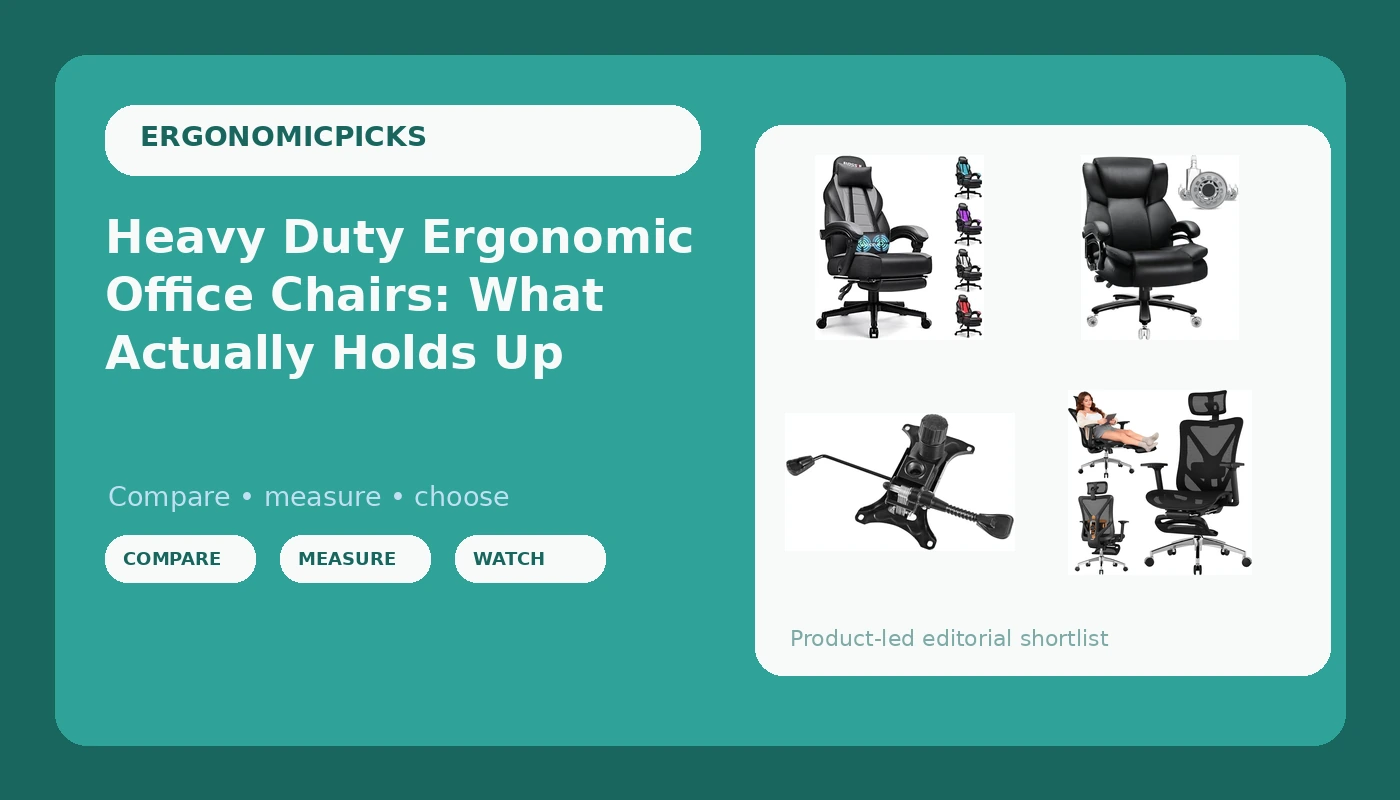
Most people shopping for a heavy duty ergonomic office chair are solving two problems at once: their current chair is failing, and it was never right for their body in the first place. Those are different failures. A gas lift that quits at month fourteen is a durability problem. A seat pan that presses into the back of your knees is a fit problem. Buying a heavier-rated version of the same wrong chair fixes the first and does nothing for the second. I am a physical therapist who spends most of the week doing ergonomics work for offices, and the pattern is consistent: people upgrade to a chair rated for 300 pounds or more and then sit in it exactly the way they sat in the broken one. Weight capacity matters. It is simply not the spec that changes how your back feels at hour six.
Related: How to Set Lumbar Support So It Stays Put All Day →
Quick answer
A heavy duty ergonomic office chair earns that description through three things: a base and cylinder rated for your weight, a seat pan deep enough for your thigh length without pressing behind the knee, and a backrest whose lumbar curve moves up and down and stays where you lock it. Weight rating is the easiest spec to check and the least likely to resolve pain. If your old chair failed mechanically rather than never fitting, price a replacement mechanism before you buy an entirely new chair.
Four useful options
| Model | Best fit | What stands out |
|---|---|---|
| GABRYLLY Ergonomic Office Chair with Footrest, 135° Reclining Desk Chair with Adjustable Lumbar Support,3D Armrest,Headrest & Large Steel Base, 300LBS Heavy Duty Mesh Chair | Long days with recline breaks | Adjustable lumbar, 3D armrests, headrest, 135° recline, large steel base, 300 lb rating |
| BOSSIN Gaming Chair with Massage, Ergonomic Heavy Duty Design with Footrest and Lumbar Support, Large Size Cushion High Back Office Chair, Big and Tall Gaming Computer Chair for Kids | Deep recline with a footrest | Massage function, footrest, lumbar support, large high-back cushion |
| Big and Tall Office Chair, Heavy Duty Office Chair for Heavy People | Wider, heavier riders | Marketed specifically as a big and tall heavy duty chair |
| Heavy Duty Office Chair Tilt Control Mechanism Rreplacement Part 10 x 6 | Repairing a failed tilt mechanism | Tilt control replacement part sold on its own |
The adjustable mesh chair: GABRYLLY Ergonomic Office Chair with Footrest
The adjustable lumbar pad is the reason this one is worth a look before the others. On most chairs in this range the lumbar "support" is a pad that slides a few inches and then creeps back down by mid-afternoon. What you want to confirm before buying is whether the pad locks at a height and holds there. Mesh is the second thing to think about. Mesh keeps air moving, which matters over a nine-hour day, but the quality of the weave decides whether the seat edge still holds its shape in year three or sags into a hammock under your tailbone. The 300 lb rating is a claim about the base and cylinder, not about how the chair fits you. If you are shorter than about 5 foot 6, check the seat depth before you commit, because a deep pan on a mesh chair puts pressure behind the knees and pushes you forward into a slouch.
The gaming-style recliner: BOSSIN Gaming Chair with Massage
Gaming chairs get dismissed in ergonomics circles, and sometimes that is fair. The bucket-style side bolsters on a deep seat push your shoulders forward when you sit upright to type, which is the opposite of what a work chair should do. Where this style does work is for tall people who want a genuinely deep recline and a footrest for breaks, and for anyone who wants a massage function in the backrest. Treat the massage motor as a comfort feature, not a therapy device. The mechanism underneath is what usually decides how long a chair like this lasts, so lean back and listen for creaking in the first week, and check whether the tilt tension can be adjusted rather than being locked at one setting.
The big and tall option: Big and Tall Office Chair, Heavy Duty Office Chair for Heavy People
Big and tall chairs solve a real problem that standard chairs ignore: a seat pan that is too narrow puts pressure on the outside of the thighs and hips, and a cylinder that is not rated for the load will fail early no matter how good the foam feels on day one. The trade-off is that a wider, deeper seat is harder to fit correctly. A big and tall chair is more forgiving in width and less forgiving in depth, so measure from the back of your knee to the back of your hip and compare that to the listed seat depth. Also look at what the listing says about the cylinder and base rather than only the cushion. Foam is the cheapest part of a chair and the first thing a manufacturer upgrades to make a spec sheet look better.
The repair part: Heavy Duty Office Chair Tilt Control Mechanism Rreplacement Part 10 x 6
Here is the part most buyers skip. If the frame, backrest, and armrests of your current chair are still sound and the only thing that failed is the tilt mechanism, replacing the mechanism keeps a chair you already know fits your body. That is often a better outcome than gambling on a new chair with a different seat depth. The catch is compatibility. A tilt control has to match the mounting bolt pattern, the seat plate, and the cylinder it sits on, and the 10 x 6 sizing in the listing has to line up with what is actually under your seat. Pull your chair, flip it over, and measure before ordering. If the gas lift is what died rather than the tilt, this is the wrong part entirely.
Prices and availability may change. Product images, names, and retailer links are matched to verified listings. No current price, rating, stock status, or measured result is stated here without current evidence.
What "heavy duty" actually means in a chair listing
Heavy duty is not a regulated term. On a product page it usually signals some combination of a thicker base, a higher-class gas cylinder, a wider seat plate, and a higher advertised weight rating. Those are real differences, and they matter most for the parts that fail under load: the cylinder, the base legs, and the point where the seat plate meets the mechanism.
The problem is that a weight rating tells you nothing about fit. A 400 lb chair can still have a seat depth that is wrong for you, a lumbar pad that will not stay put, and armrests that wobble after a month. Manufacturers know buyers scan for the number, so the number gets the attention and the adjustment hardware gets the cost-cutting.
When you compare listings, look for specifics rather than adjectives. "Heavy duty" alone is marketing. A named cylinder class, a steel base, a stated seat height range, and a weight rating are specifications you can actually check against your body and your desk.
Seat depth, lumbar curve, and tilt tension
These three settings decide whether a chair is comfortable at hour one and still comfortable at hour seven.
Seat depth is the distance from the front edge of the seat to the backrest. Too long and the edge presses into the back of your knees, which pulls your feet forward and flattens your lower back. Too short and your thighs are unsupported, which loads the hips. The rough target is two to three fingers of clearance between the seat edge and the back of your knee when your back is against the backrest.
The lumbar curve is the inward curve of your lower back. A chair supports it only if the pad sits in the right place for your torso length and stays there. A pad that slides down under body weight is not lumbar support, it is a cushion.
Tilt tension is the resistance when you lean back. Too loose and you slouch into the recline within an hour. Too stiff and you stop using the recline at all, which means you sit locked in one position all day. You want a mechanism where the tension can be set so the chair holds you at a slight recline without you fighting it.
A five-step way to decide
- Measure your knee-to-hip length and compare it to the listed seat depth before you read anything else on the page.
- Find the stated weight rating, then check what it applies to, meaning the base and cylinder rather than the cushion.
- Confirm the lumbar support moves up and down and locks, not just that the listing says "lumbar support."
- Check the armrests. If they are fixed height, measure whether they land under your elbows at your desk height.
- Decide repair versus replace. If the frame and back are sound and only the mechanism failed, price the part first.
Practical guidance before you buy
- Sit at your actual desk height before committing. A chair that feels fine at a display counter can be wrong at a keyboard.
- Give a mesh seat three full workdays before you judge it. The first two hours tell you almost nothing.
- Plan on five years of use. A cheap mechanism that fails at month eighteen was never the cheaper chair.
- Keep the armrests in play. Floating elbows are how shoulder pain starts, so make sure the arms adjust to your elbow height.
- Recheck the listing for the exact seat dimensions and weight rating, because the numbers that matter are the ones you verify yourself.
Which option should you choose?
Choose the GABRYLLY Ergonomic Office Chair with Footrest when you want the most named adjustment points in the group and you will actually use an adjustable lumbar pad and 3D armrests. Choose the BOSSIN Gaming Chair with Massage when you want a deep recline, a footrest, and a massage function, and you are tall enough that the deep bucket seat will not push your shoulders forward. Choose the Big and Tall Office Chair, Heavy Duty Office Chair for Heavy People when seat width is your main constraint and you need a chair built for a heavier rider. Choose the Heavy Duty Office Chair Tilt Control Mechanism Rreplacement Part 10 x 6 when your current chair still fits you and only the tilt mechanism has failed.
No chair in this group is one size fits all, and any listing can change its specifications without notice. Verify seat depth, weight rating, and adjustment hardware on the product page, and if you have an existing back or hip issue, treat the chair as one part of the setup alongside desk height, monitor position, and how often you stand up.
The bottom line
A heavy duty ergonomic office chair is a five-year purchase, and the specs that decide whether you still like it in year three are seat depth, a lumbar pad that locks, and a mechanism that does not fail under load. The GABRYLLY listing carries the most adjustment hardware, the BOSSIN covers the recline-and-footrest preference, the big and tall option addresses width for heavier riders, and the replacement tilt mechanism is the option most people never consider. Measure your body first, match the numbers to the listing, and buy the chair whose adjustments fit you rather than the one with the loudest weight rating.